
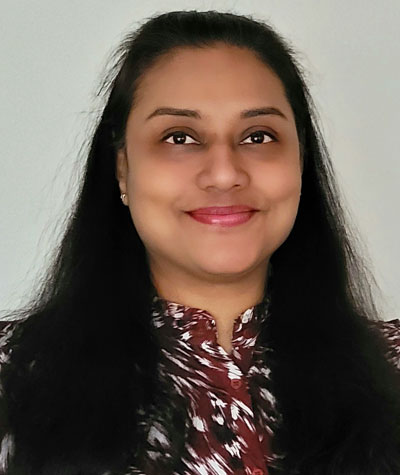
Ms Sujatha Udayasankar is a specialty doctor in General Surgery at Hywel Dda University Health Board, Wales and an RCS England SAS Forum member. She grew up in south India and came to the UK in 2004 after graduating in medicine. She completed foundation training in England before moving to Wales to undertake her core surgical training. In 2014, Sujatha was appointed to the role of specialty doctor. Having established herself in her clinical role, Sujatha has extended her learning and development.
Coaching and mentoring
As of early 2023, Sujatha is one of a few doctors in her Health Board trained to be a coach. She holds a postgraduate certificate in Clinical Leadership from Swansea University and a level five coaching and mentoring qualification from the Institute of Leadership and Management (ILM).
Sujatha coaches doctors in training and her peers, as well as allied healthcare professionals. “One of the biggest differences between a coach and a mentor is that coaching is very specific. I’ve focused on coaching people for leadership roles,” says Sujatha. She explains that coaching is a short-term, focused intervention, whereas mentoring takes a longer-term approach and focuses on the whole individual. Sujatha has focused her mentoring skills on supporting SAS doctors new to role and those wanting to pursue CESR. She says, “People really like to have somebody to bounce ideas and thoughts within a safe psychological space.”
Clinical innovation award
Sujatha has developed an interest in quality improvement and national clinical audits. She has completed Health Education and Improvement Wales (HEIW) silver IQT training (now called QIST Improvement in Practice Workshop). In 2018, she was honoured by HEIW at an event hosted by the British Medical Association (BMA) in Cardiff, where she received the BEST SAS Award for Clinical Services Innovation 2017. The award reflected a string of quality improvement activities Sujatha had initiated at the Breast Care Unit at Prince Philip Hospital, Llanelli. At the time, she said: “This award is a recognition of the importance of quality improvement within the NHS. I aspire to drive and encourage a strong culture of quality improvement within clinical teams at a multi-disciplinary level to improve patient safety, efficiency and clinical effectiveness.”
Sujatha had the opportunity to get involved with and lead national audits in her department. These experiences have prompted her to apply for leadership positions. “That’s where I’m trying to get to. I want to be able to make a meaningful difference,” she says.
Sujatha highlights how expanding her interests within the Health Board has led to new opportunities. Getting involved in quality improvement brought her into contact with a wide range of stakeholders. She has developed an interest in teaching students, foundation, and core training doctors, which in turn paved the way to her becoming an Honorary Tutor at Cardiff University and Clinical Assessor for Swansea University medical students.
“The more we open up opportunities to SAS doctors, the more we will encourage them to take up those opportunities.”
Stepping onto the leadership ladder
Sujatha is a SAS representative at the Local Negotiating Committee and sits on her Health Board’s SAS Steering Group and BAME Advisory panel. She says: “This enables me to voice SAS opinions and address any issues with the senior management. I must admit it is reassuring to see the senior management involved and committed to listen and make necessary changes.”
Sujatha has applied for several leadership positions and has been shortlisted. She believes there remains cultural resistance, and despite the Health Board opening all leadership positions to both SAS doctors and consultants, there remains a perception that leadership roles are for consultants. “I think it takes time for people to accept the change. However, it is in the hands of current leaders who can build capability by empowering interested and potential SAS doctors into leadership and management roles. And, we are slowly beginning to see this shift,” she says.
Sujatha decided that she needed a plan for how she wanted her career to develop over the next few decades and what it would take to get there. She said: “I want to improve our service, and that needs strong leadership. I decided to do a leadership course so that I could come back with more ideas to support my department.” This led her to participate in the Health Board’s aspiring medical leaders’ programme, as detailed below.
Aspiring medical leaders’ programme
Christine Davies, Assistant Director for Organisational Development, ran the programme together with Phil Kloer, Deputy Chief Executive and Executive Medical Director. There were two cohorts, each comprising 20 doctors: consultants, GPs, and SAS doctors (including Sujatha). “From those 40 people, 70% of them have gone on to different types of leadership roles – whether that’s an assistant medical director or clinical lead for audit – so those two cohorts have given us a strong leadership body,” says Christine.
The programme focused on real-time organisational learning and required participants to give a presentation on a leadership challenge to get support from the group on how to tackle it. Sujatha’s challenge was how to get the organisation to engage with the SAS Charter.
The leadership programme was paused when the COVID-19 pandemic hit, and attention has since shifted to its off-shoots, including peer mentoring programmes for consultants and SAS doctors, a coaching programme, and a SAS Charter Steering Group.
Advice on stepping into leadership
Sujatha’s tips for SAS or LE doctors wanting to get into leadership roles:
- Develop a portfolio of interests: Sujatha has taken on a range of additional roles that have brought her into contact with people outside her department. She says: “We need SAS doctors to be present and visible in different roles. Expand your horizons.”
- Have a voice: Until a few years ago, SAS doctors were not given supporting professional activities (SPA) time. SAS doctors have challenged this and now they receive SPA for learning and development. “You have to ask. SAS doctors need to speak up and be ready to appropriately challenge old ways of working. Only then can we build a new future,” says Sujatha.
- Build allyship: Know your leaders within the organisation, in your deanery and in the respective Royal colleges. “There are many people who are very appreciative and truly supportive of SAS doctors’ roles and capabilities. We have made a lot of progress at the RCS SAS Forum in recent years and encourage our SAS Surgeons to come forward and join us,” says Sujatha.
- Make use of the support available: Sujatha advises SAS doctors to draw on the support available within their organisation, such as coaching and mentoring, leadership courses, and the support of their SAS Steering Group, if they have one. “There is a wealth of information and support networks. It is about how we use it,” says Sujatha.
- Plan your career development: New SAS doctors will have 25-30 career years ahead. Sujatha advises them to start planning early. With targeted coaching and mentoring, SAS doctors can determine their own career trajectory.
SAS Charter Steering Group
The SAS Charter Steering Group is co-chaired by Christine and the deputy Medical Director. Sujatha sits on Group, together with SAS and medical workforce colleagues. The Group is working to progress the implementation of the SAS Doctor and Dentists Charter for Wales. “It was given more energy during the pandemic because one of the things that emerged in Wales was how health inequalities were being experienced by minority ethnic communities. That led to our Health Board establishing a BAME (black and minority ethnic) advisory group to the board,” says Christine. Many SAS doctors in Wales are from minority ethnic backgrounds, which increased the impetus for the SAS Charter Steering Group.
Of the SAS Charter, Christine says, “It really helped us to start listening more to our SAS body, so we’ve conducted several listening exercises with SAS doctors.” For example, hearing about the barriers SAS doctors can face in becoming a consultant via the CESR route led to the appointment of a CESR champion. The Health Board has also appointed SAS Advocate.
Christine reports that discussions within the SAS Charter Steering Group have shone a light on expectations around job planning and SPA time – for research, leadership and education. It has enabled dialogue with clinical leads across the Health Board.
Medical director perspective
“We didn’t know what impact [the aspiring medical leaders’ programme] would have. We knew that we hadn’t really invested in leadership for SAS, so we wanted to test it. And it has had lots of ripple effects,” says Phil Kloer. “Compared to when I started, when we had zero SAS doctors in leadership positions, we have since had quite a number of applications for different roles. We have had SAS doctors, particularly in quality improvement roles, and they’ve been brilliant.”
“I think it’s quite tricky for SAS doctors because they haven’t had a voice for so long, and they haven’t been used to being thought of as leaders.”
Phil delivered a talk for SAS doctors that emphasised taking a leadership mindset. “I said, leadership isn’t about the badge. We need leadership at every level. I think it’s really important for SAS doctors that they know how to recognise when they’re a leader in their environment and when they’re taking on leadership roles because we all impact on the culture, every single one of us.”
Another area the Health Board has paid attention to is onboarding. Many of its SAS doctors are international medical graduates (IMGs). “We became aware that there were some people arriving outside our hospitals with suitcases, and they didn’t know the area. They didn’t know who they were to meet. It might be out of hours. And that’s such an awful situation to be in,” says Phil.
The Health Board’s onboarding process has several aspects – from recruitment and the welcome to the UK (to ensure new doctors from overseas know where they are staying and how to get around the hospital) to the educational and spiritual aspects (such as where the closest place of worship is) and peer support.
As an IMG, Sujatha understands the challenges faced by doctors from overseas in trying to assimilate into the NHS. She sits on the Health Board’s BAME network and says the support ranges from helping with visa applications to orientating doctors on arrival in Wales. In addition, to help them settle into the post, new IMGs are provided with a “buddy” or mentor for the first six months to help them think about their career.
In 2015 a large group of doctors from overseas joined the Health Board. Consultants were taken off the rota to assess the competencies of each new starter. This process led to the realisation that a proportion had competencies at a grade below expected at recruitment. “We did that initial assessment very early and then put them in the grade they could work in because it’s really unkind to put somebody in a job which they can’t do,” says Phil. The assessment provided an understanding of where the gaps were for these doctors; the more junior doctors were given an educational portfolio (like doctors with a national training number).
Phil sums up the Health Board’s approach as follows: “We’re paying attention to some of the really important aspects of onboarding and leadership development. We’re trying to use our values because trying to be kind to each other is a good start, and I don’t think people have been kind enough to SAS doctors over the years.”
Advice from organisational development for SAS doctors
Christine’s advice for SAS doctors wanting to develop beyond their clinical roles:
- “Think about developing your networks and not just within your specialty but across the organisation, in terms of education, research, quality and safety.”
- “Postgraduate tutors are always a great source of advice.”
- “Know your medical director’s organisational structure, including who is assistant director of medical education and who is the assistant director for quality and safety”
- “Always ask if you want some support, if you want to be mentored, or if you just want to have a conversation with your chief executive – ask.”
- “The management body is not your enemy. Get to know them. They can help you.”
- “If you’ve got an audit department, go and find out what they do.”
- “Talk with your peers. Develop a sense of agency about being able to create a collective future. Make space to do that because it’s important for your resilience.”
