
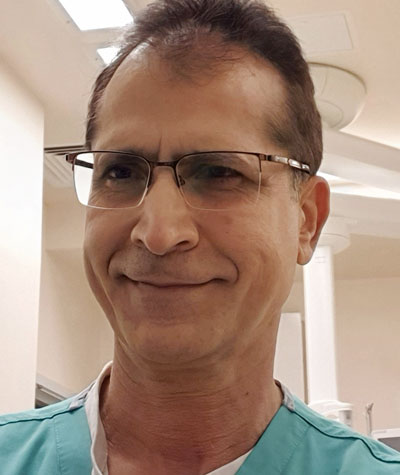
Mr Ishtiaq Aziz’s journey into clinical research reflects the support he describes having received from senior colleagues within the vascular department at Norfolk and Norwich University Hospitals NHS Foundation Trust (NNUH). Consultant colleagues were said to have valued the experience and skills he acquired over 20 years in Malaysia and Pakistan before coming to the UK. This included being a senior lecturer in Kuala Lumpur. “They didn’t let me waste those skills… they recognised my previous experience and they allowed me to build on from there”, says Ishtiaq.
Factors that Ishtiaq considers important to his journey into research include senior colleagues providing references to support his applications for fellowships with the European Board of Vascular Surgery and the Royal College of Surgeons of England, as well as encouraging him to participate in research projects. Demonstrating an interest in undertaking research opened up opportunities. “You have to show your interest and that you are capable of doing something”, says Ishtiaq. Noting this interest, Professor Philip Stather, consultant vascular surgeon and Clinical Associate Professor at the University of East Anglia, offered Ishtiaq the position in 2021 as research lead for SAS and registrars. Professor Stather said, “Ishtiaq showed an interest in research and had the right experience. As a permanent member of staff he could see the projects through”.
Ishtiaq’s role involves coordinating research activities by surgical registrars in training, SAS surgeons and locally employed doctors (eg clinical and international fellows). Ishtiaqis engaged in multiple research-related activities, including presenting an e-poster at the 36th Annual Meeting of the European Society of Vascular Surgery in Rome in September 2022, co-authoring an abstract (Outcome of surgical revascularisation of acute upper limb ischemia- A single centre experience), and presenting at the 2022 annual meeting of the British Society of Endovascular Therapy (BSET). He is Trust lead for national level audits and studies (CASCADE-Cardiovascular Outcomes After Major Abdominal Surgery, CAASP-Collaborative Acute Aortic Syndrome Project, DEFINITE-Diabetic Foot Debridement in Theatre, a VERN collaborative project). Professor Stather advises any doctor wanting to get more involved with research to begin by focusing on collaborative projects, “because it gives you the insight into what you need to do and how to design a study.”
Ishtiaq credits the culture at the NNUH for facilitating his journey from general to vascular surgery, and into research. Asked to describe the culture, he says: “If you are capable of doing something you are given the chance, irrespective of where you’ve come from.”
Dr Aziz’ advice for SAS doctors wanting to get involved in research
Adopt the right mindset – SAS doctors can actively participate in research projects, so don’t be put off by thinking this isn’t for you.
Start simply – take the first step; departmental or internal audits are a good starting point. Offer yourself for data collection (not everyone likes it!). Familiarise yourself with various data-collection options. Get to know your Trust statistician; he/she can be very helpful.
Be alert to unusual cases – SAS doctors always come across unusual presentations and less common clinical conditions. Consider writing up the case for publication (observing guidance on using patient information – see resources).
Progress to more complex projects – move on to develop your skills in research. Working knowledge of applied statistics will be valuable. The next time a research project comes up, you will be better placed to make a bigger contribution, such as participation in randomised controlled trials and meta-analyses.
“I believe that active participation in research is one of the most effective ways to improve patient care.”
Resources
- RCS England guidance for surgeons on using data to support change in clinical practice
- Relevant GMC guidance includes: Good practice in research; Consent to research; Using patient information for research purposes; Recordings made for research teaching training and other healthcare related purposes
- AoMRC guidance SAS doctors / dentists and research
Ishtiaq’s career journey
Advice for getting involved in research, by Professor Stather, consultant vascular surgeon and Clinical Associate Professor at the University of East Anglia
Start with simple things and build up your experience – “Regardless of your level, whether medical student or a consultant who wants to start on an academic path, start with something that is not too onerous, will give you an output and where you have a clear objective. Once you’ve started working out how to write a publication then you can build up to more things”. He adds: “If you can get involved with any collaborative, it’s a really good starting point to get your research portfolio underway.”
Look out for in-work training opportunities in research – such as the Associate Principal Investigators (PI) scheme, which can provide the next level of experience in helping to run randomised controlled trials.
Don’t feel limited by geography – systematic reviews and meta-analyses can be done from wherever you are in the country, “It’s about collaborating and working with the right people in order to achieve that”.
Identify a consultant supervisor – you don’t need an academic supervisor for collaborative projects as they are run centrally, but if you want to make research a big focus of your career, you’ll need a consultant supervisor (even consultants require mentorship). Professor Stather says, “It’s really hard to trailblaze in research especially if you’re not senior enough – you need a supervisor at the start. If you want to be a full-flung academic and aim to be a professor, I’d advise you get the right supervision and advice in a unit where you can achieve that.”
